July 7, 2026

Take Control of Ad Refresh Timing with Refresh Overrides
Published By
Ben Spencer
Time
Reading Time
3 min
Chat
Chat

d refresh is one of the most powerful levers publishers have for maximising revenue - but until now, the duration has always been set at the config level. That's great for broad control, but what if you need something more surgical?

Meet Refresh Overrides: a new feature in Fusion that lets you define a specific refresh duration based on exactly what came back from the ad server.

How it works

Inside your Google Ad Manager (GAM) Integration in Fusion, you'll find a new Refresh Overrides section Add an override, pick your ID type - Advertiser, Order, Creative, Creative Template, or Line Item - enter the ID, and set your duration.

When Fusion detects a match on page, that override takes effect immediately, regardless of what your config-level refresh duration is set to. Got one config running at 30 seconds and another at 35? Both will honour your override if the ID matches. It's dynamic, clean, and requires no changes to individual configs.

This pairs naturally with the recently launched Refresh Blocking feature, which lets you stop refreshes from firing altogether for specific IDs - useful for high-value creatives or advertisers where a single, uninterrupted view is worth more than multiple refreshes.
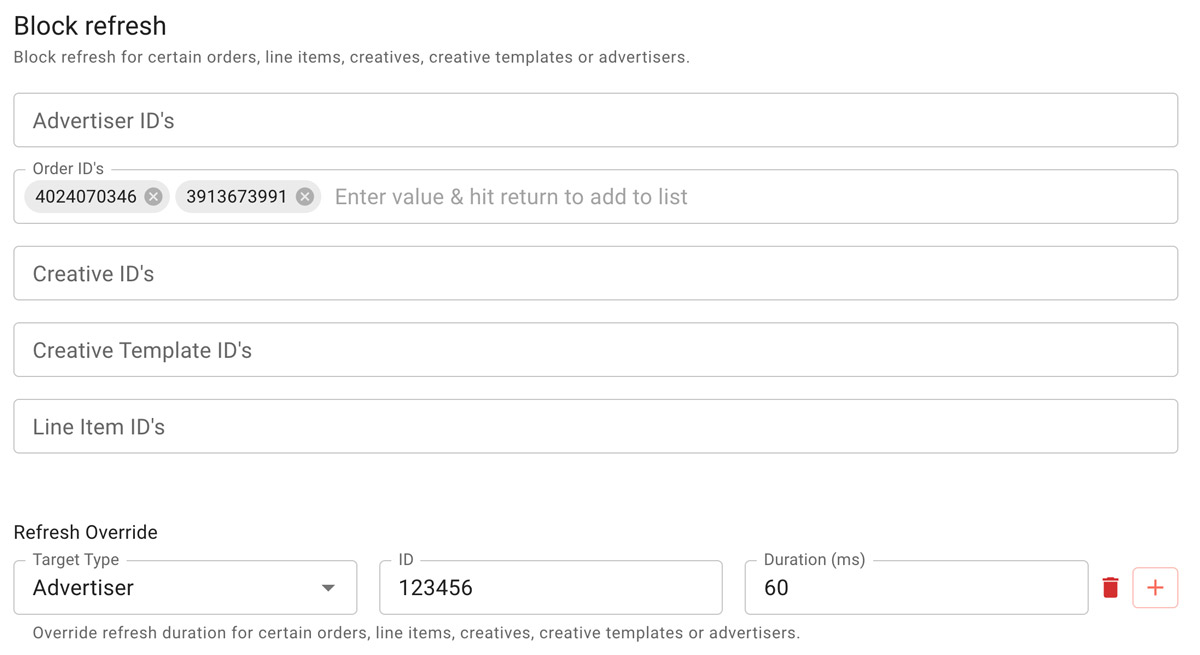
Block Refresh on certain GAM Advertiser / Order ID's or add specific refresh times for particular campaigns

A small but important behaviour change

To make overrides work, we've made a subtle change to how refresh timing operates under the hood - and it's worth being aware of.

Previously, the moment Fusion determined a refresh was needed (unit in-view, timer elapsed), it would fire the ad request and simultaneously queue the next refresh timer. Fast and efficient.

Now, Fusion sends the ad request, waits for the response - ad or no ad - and then queues the next refresh. This is necessary because the response is what determines the next duration when an override is in play.

In practice, the delay is milliseconds. Ad requests are built and dispatched almost instantly, so the impact on overall refresh cadence is minimal. Over a long session with many refreshes, it's theoretically possible this could cause you to miss one refresh - but in testing, it doesn't materialise at typical publisher dwell times.

If you ever do notice an impact on impression volumes, the fix is simple: reduce your refresh duration slightly to compensate.

Who's this for?

Refresh Overrides won't be relevant for every publisher - it's a precision tool for specific use cases. Think advertiser guarantees, campaign pacing, or protecting premium line items from over-refreshing. If that's something you manage today manually or via workarounds, this should make your life noticeably easier.

You'll find the feature inside your config settings in Fusion. As always, if you'd like a walkthrough or want to discuss how overrides might fit into your setup, your account manager is happy to help.

Latest Articles

Latest Articles By Content Ignite

Content Ignite and The GoodNet partner to bring ESG data to Publishers

Content Ignite, the advertising technology platform which gives publishers complete control over on-page monetisation, ad technology, and ad management, has joined forces with The GoodNet, the ESG data company that connects business performance and sustainability goals.

View Article

Content Ignite Unveil the ‘Publisher Hub’: Transform Your Revenue Strategy

Content Ignite has unveiled the Publisher Hub—a comprehensive platform consisting of three key areas: Ads.txt Insights, Core Web Vitals monitoring, and Revenue Analytics.

View Article

Content Ignite is delighted to announce its certification as a Google Certified Publishing Partner (GCPP)

Content Ignite, the publisher-first advertising technology and monetisation platform, is delighted to announce its certification as a Google Certified Publishing Partner (GCPP).

View Article

Optimising Website Ad Performance Using Content Ignite’s Experiment Technology

Content Ignite’s advanced experiment technology now offers a powerful platform for publishers to test, refine, and perfect their ad revenue strategies

View Article

Boosting Publisher Revenue: The Role of Demand Path Optimisation (DPO) and Split Testing

As no clear path or definitive solutions have emerged, it is vital that publishers explore new areas, test new partners and experiment with new technologies to maintain their revenue streams.

View Article

DPO vs SPO - What’s the difference?

Demand Path Optimisation (DPO) and Supply Path Optimisation (SPO) are two strategies in digital advertising, specifically in the programmatic ecosystem, aimed at improving the efficiency and transparency of the ad supply chain. Both focus on optimising different parts of the ad transaction process, but from different perspectives.

View Article

Impressed? Signup or reach out for your free healthcheck

We only need your email and domain to complete each healthcheck

Preferences

Privacy is important to us, so you have the option of disabling certain types of storage that may not be necessary for the basic functioning of the website. Blocking categories may impact your experience on the website. More information

Accept all cookies

These items are required to enable basic website functionality.

Always active

These items are used to deliver advertising that is more relevant to you and your interests.

These items allow the website to remember choices you make (such as your user name, language, or the region you are in) and provide enhanced, more personal features.

These items help the website operator understand how its website performs, how visitors interact with the site, and whether there may be technical issues.

Thank you! Your submission has been received!
Oops! Something went wrong while submitting the form.