

Interstitials have a reputation problem. Publishers hear "full-screen ad" and immediately think intrusive, risky, reader-unfriendly. We get it. We've had the same conversation.
But here's the thing: that reputation doesn't hold up when you look at what's actually happening on publisher pages right now.
The sticky video problem
Outstream video has been the go-to premium format for years. The CPM headline looks good, and advertisers clearly value video inventory. So far, so straightforward.
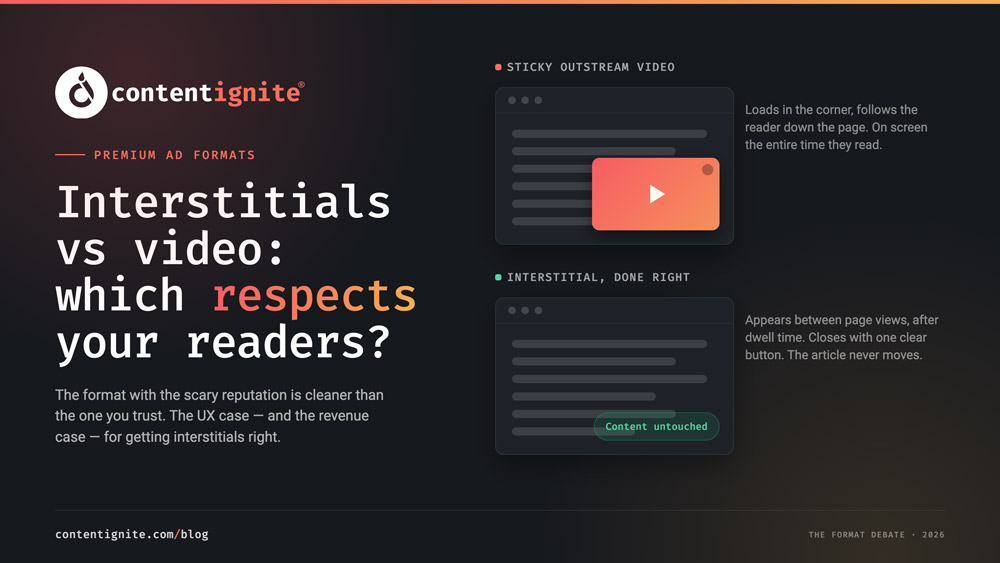
But the way most outstream video actually lands on a page? A player that loads in the corner, starts playing automatically, and then follows the reader down the page as they scroll. It sits in the bottom-right corner of the screen the entire time someone is reading your content. It doesn't go away.
Instream video isn't much better from a reader's perspective. Most people find pre-roll and mid-roll formats genuinely annoying, which is a big part of why ad blocker adoption keeps growing.
So when we talk about video being the "less intrusive" option, it's worth asking: less intrusive than what, exactly?
What a well-implemented interstitial actually looks like
A properly set-up interstitial appears between page views or after a reader has spent a meaningful amount of time on a page. It doesn't interrupt reading. It doesn't sit on top of an article. It doesn't play sound.
The reader sees the ad, closes it with a clear button, and carries on. The content before and after is completely untouched.
That's a clean, respectful ad experience. Not a perfect one, but a fair one.
The revenue case is solid
Beyond the UX argument, the numbers are worth knowing.
On the open web, average programmatic display CPMs on the Google Display Network sit around $3.12 (roughly £2.45). Private marketplace deals average around $8.20 (roughly £6.45). Interstitials sit firmly at the premium end of that display range, and the reason is straightforward: viewability. Full-screen web interstitials deliver close to 98% viewability, compared to a 50 to 60% average for standard display banners. Advertisers pay for viewability, and that gap shows up directly in CPMs.
Outstream video CPMs on the open web can range from around $4 at the lower end on mobile web (roughly £3.15) up to $10 and beyond in private marketplace deals (roughly £7.85+). But that headline range is under pressure. Average video CPMs dropped around 11% year-on-year as more outstream inventory entered the market and supply outpaced demand. Stricter IAB regulations on outstream and instream placements have also weighed on fill rates and bid volumes through 2024 and into 2025.
Interstitials are still relatively uncommon on publisher sites, which keeps supply tight. Scarce, full-screen, near-100% viewable inventory is exactly what programmatic buyers compete for. That scarcity, combined with the viewability signal, is what gives the format its pricing power on the web.
The "covers content" argument doesn't stack up
The most common objection to interstitials is that they cover content. It's worth looking at that honestly.
An interstitial shown between page views, or triggered after a dwell threshold, appears when the reader isn't actively reading anything. Very much like browsing your favourite newspaper or magazine, where you get a full-page ad between pages, it’s not disrupting your reading experience. The content isn't there yet. Compare that to a sticky video player sitting in the corner of the screen while someone reads an article. That ad is literally covering part of the page the reader is on, at all times.
If covering content is the objection, sticky outstream video has the same problem.
Getting it right matters
None of this means interstitials can be deployed without care. Google is clear on what crosses the line: ads on initial page load, units that can't be dismissed, interstitials that block access to content. Those implementations are rightly penalised.
But a frequency-capped interstitial, shown once per session after a defined dwell time, with a visible close button, meets Better Ads Standards and passes Google's Ad Experience Review. It also delivers a full-screen creative environment that a corner video player simply can't replicate.
Where we think this is heading
High-impact premium formats are a key revenue pillar for publishers under pressure. The challenge isn't whether interstitials work. It's making sure they're implemented well.
Publishers who get the setup right, with proper frequency capping, sensible triggers, and clean close mechanics, are well placed to benefit. Outstream video will stay in the mix, but it's not the only answer. And it's not automatically the friendlier one.
Interstitials, done properly, are one of the cleanest ad experiences available to publishers today. The data supports it. The user experience case does too.